
Understanding Maine Coon
Color
The Science Behind Extraordinary Coat Colors

Every Maine Coon coat begins with a base pigment.
Genes then shape its color, pattern, and expression. Follow the layers below to see how these features come together.
Base Pigment
Level 1
Eumelanin
The pigment behind black-based coat colors.


Black pigment
Without the Orange variant, the coat remains black-based.

Phaeomelanin
The pigment behind red-based coat colors.
Red pigment


The Orange variant produces red-based color.

Tortoiseshell
Females with orange and non-orange variants can express both pigments, creating a mosaic of black-based and red-based patches.
Black and red pigments
Every tortie combines black-based and red-based color.
The pattern beneath the coat
Coat genetics influence whether a cat’s underlying tabby pattern is hidden or visible.

Level 2 — Agouti: Visible or Hidden Pattern
Agouti influences whether the tabby pattern is visible.

Agouti
Tabby pattern visible.
OR
Non-agouti
The tabby pattern is hidden; the coat appears solid.

Level 3 — Tabby Pattern
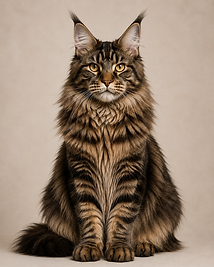
Ticked tabby
Mackerel tabby
Classic tabby
Spotted tabby
Banded individual hairs, with little or no visible body striping.
Narrow, vertical “fishbone” stripes along the sides.
Bold swirls and distinctive “bull’s-eye” markings.
A pattern of spots rather than continuous stripes.


Level 4 — Dilution: Blue and Cream
Dilution softens black to blue and red to cream.

No dilution
Black remains black.
Red remains red.
OR
Dilution (recessive)
Black becomes blue (gray).
Red becomes cream.


Level 5 — Inhibitor: Silver and Smoke
Creates a silver-white foundation by reducing pigment near the base of each hair.
Agouti + inhibitor = silver
A visible tabby pattern against a silver background.

Solid + inhibitor = smoke
A silver-white undercoat beneath colored tips.

Red base + inhibitor = cameo
Red-based color with a silver-white foundation.

Level 6 — Wide Band: Shaded and Shell
Influences how far the pale band extends along each hair.
Lower expression
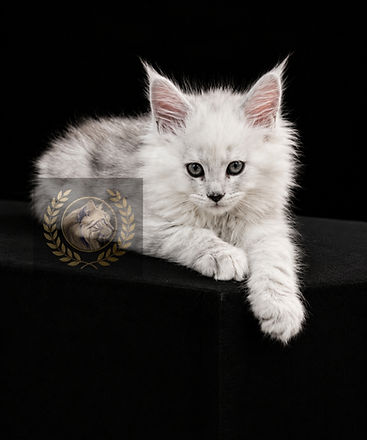
Black silver tabby
Moderate expression
Black silver shaded

Higher expression
Black silver shell

Often called a Chinchilla, although this term is more commonly used within CFA, the TICA calls this specific color a Shell.
Level 7 — Additional Modifiers
Finishing details

White spotting
The amount and placement of white markings.
Eye color
Gold, green, copper, or odd-eyed variations.
Rufism
Warm red or yellow tones within the coat.
Dominant white (W)
A white coat that masks the underlying color and pattern.
Other factors
Environment, nutrition, and epigenetics can influence the coat’s appearance.


The beauty of genetic variety
Each coat reflects a unique combination of inherited color and pattern variants.