%20(3).jpeg)
Maine Coon History: From New England to the Show Ring

Updated: Sep 9
A silver collar, a well-loved family portrait, and a cat with the wonderfully grand name Captain Jenks of the Horse Marines: Maine Coon history is full of details that make the past feel surprisingly close.
Long before the breed appeared in beautifully photographed kitten announcements, people were noticing these cats, talking about them, and finding ways to remember them. Some were admired for their usefulness. Others drew attention in exhibition halls. Many mattered most in the homes where they lived.
The story carries us from nineteenth-century New England to the organizations that helped establish the modern breed. Along the way, it introduces the owners, exhibitors, and enthusiasts whose affection for Maine Coons left something lasting behind.
Maine Coon History Begins in New England
Maine gives this breed both its name and its regional roots. The state's Maine Atlas Project traces its background to domestic cats brought to New England by settlers. By the 1800s, the region's Maine cats were valued as capable mousers, with substantial paws and coats suited to the cold. Maine Atlas Project.
That working background is a fitting place to begin. Before a cat could be discussed in the language of show standards, someone knew it as the familiar animal around a home or property. The relationship between usefulness and affection is part of the breed's early appeal.
There is no single recorded founding pair that supplies a neat first page. Instead, the Maine Coon emerges from a regional population of domestic cats, gradually becoming recognizable and celebrated. Its history belongs to a place and a community before it belongs to a modern registry.
Captain Jenks and the Cats People Remembered
In 1903, Frances Simpson's The Book of the Cat included a chapter on Maine cats by Mrs. E. R. Pierce. She recalled sharing a longhaired black-and-white cat with her younger brother as early as 1861. His name was Captain Jenks of the Horse Marines.
The date is a remembered moment from her family life, recorded decades later in the book. The extraordinary name is a delightful introduction to an ordinary truth: people were already giving these cats a cherished place in their homes.
Pierce remembered fine cats being given to friends who would care for them. She also described a cat named Dot who went to a Bangor show and returned with an elaborately inscribed silver butter dish. Years later, she wished she still had the prize to illustrate her account. Pierce's “Maine Cats” chapter, published in 1903.
These little details make the early cat fancy feel wonderfully human. There were proud owners, memorable names, unexpected prizes, and the same impulse to show someone a remarkable cat that remains familiar today.
The Legends That Traveled With the Breed
The Maine Coon also collected a generous share of folklore. Stories connected the breed to Marie Antoinette's cats, longhaired cats traveling with seafarers, and even raccoons. TICA records several of these tales in its breed history. TICA's Maine Coon history.
The raccoon crossing is biologically impossible. The royal and seafaring stories remain legends rather than established pedigrees. They belong to the culture surrounding the cat, even though they do not provide a documented family tree.
It is easy to understand the attraction of a dramatic beginning. A striking cat seems to invite an equally striking explanation. Yet the regional story has its own appeal: generations of domestic cats, a demanding climate, and people who gradually recognized something worth celebrating.
The Maine Coon does not need a palace or a mythical ancestor to have a memorable history.
1895: Cosey Steps Into the Spotlight
One of the most famous names in that history is Cosey, an award-winning cat at the National Cat Show held at Madison Square Garden in May 1895.
The show's surviving catalogue provides a fascinating glimpse of the competition. Cosey appeared among the longhaired entries and competed for a special prize for the best longhaired cat in the show. The silver collar associated with that award became one of the breed's most recognizable historical objects. Catalogue reproductions are available through the joint historical project of the CFA Foundation and the Harrison Weir Collection. Cosey and the 1895 catalogue.
Earlier American cat exhibitions had already taken place; 1895 was an important landmark rather than the country's first cat show. What makes this occasion especially vivid is the combination of a named cat, a documented competition, and awards that survived.
There is something irresistible about a prize made for a cat to wear. It brings the formality of a show result back to its individual winner: Cosey, whose name is still being read more than a century later.
A Second Chapter for Cosey's Silver Collar
The collar's story continued far beyond the exhibition.
In 1990, collector Bobara Pendergrast followed a tip to an antique shop in New Jersey. There she found a silver collar, a medal, and a photograph connected with the 1895 show. According to the dealer's account, they had been discovered carefully packed away during an estate sale.
Pendergrast's curiosity helped bring the objects back into the cat world's view. The CFA Foundation acquired the group in 1992 for its historical collection, supported by a donation from the National Capital Cat Show. The CFA Foundation's account of the discovery.
A prize that someone had kept safe became a shared piece of breed history. It is a lovely reminder that preserving the past can begin with something very personal: deciding that a photograph or small object matters enough to keep.

From Early Fame to a Quieter Period
The Maine Coon's place in the show ring did not advance in a straight line. As other pedigreed longhaired cats became fashionable in the early twentieth century, Maine cats appeared less prominently in registries and exhibitions.
CFA's historical account describes this decline in show visibility and the later work that brought the breed forward again. The cats had not vanished from homes; the organized enthusiasm around them needed rebuilding. CFA's historical account.
That change of fortune adds depth to the story. Looking at the Maine Coon today, it can be difficult to imagine a period when its future in major shows was unsettled. Recognition was not simply waiting to happen. It grew from the work of people who continued to value the cats.
Their contribution was less dramatic than a silver collar, but just as important: arranging exhibitions, recording information, and giving other enthusiasts a reason to take another look.
The People Who Helped Bring Maine Coons Back
In the early 1950s, Alta Smith and Ruby Dyer formed the Central Maine Cat Club. Its activities included shows and photographic exhibitions, record keeping, and work on an early written breed standard. These efforts helped renew attention to Maine Coons.
The club's story is part of the same CFA historical record. It gives a welcome place in the narrative to the people behind the scenes—the organizers whose work connected admiration for individual cats with a more visible future for the breed.
A standard gave enthusiasts a common description to work with. Records could travel beyond one household's memory. Exhibitions brought the cats in front of new people. Together, these practical steps helped carry a regional favorite toward broader recognition.
Milestones in Modern Recognition
The following dates show that progress through several different cat registries. Each represents an important stage in the breed's organized show history.
1975–1976: CFA Recognition
CFA granted provisional status effective May 1, 1975, followed by Championship status on May 1, 1976. These milestones marked the success of years of effort to establish the breed's place within the association. CFA's recognition chronology.
1979: A Place in TICA From the Beginning
When The International Cat Association was established in 1979, the Maine Coon was accepted for Championship competition. TICA records that milestone in its breed standard. The regional American cat had a place at the beginning of a new international registry. TICA's Maine Coon breed standard.
1988–1993: Recognition in Britain
Britain's Governing Council of the Cat Fancy granted Preliminary Recognition in 1988 and Championship status in 1993. These dates describe a later chapter in the Maine Coon's international recognition, building on a story that began in New England. GCCF's Maine Coon history.
Read together, the milestones show an expanding community of people interested in preserving, describing, and exhibiting the breed.
Sandy: A Different Kind of Historical Treasure
Show prizes are only one way a cat can be remembered.
The Maine Atlas Project also shares the story of Sandy, a cat belonging to the Stevens family of Portland. In 1903, after Sandy died, Sarah Stevens painted a portrait and recorded her grief on its reverse. The work is held by the Maine Historical Society. Sandy's portrait and family photograph.
Cosey's collar celebrates a public achievement. Sandy's portrait preserves a private attachment. Placed beside each other, they suggest two equally compelling reasons people keep returning to this breed's past: the cats could draw a crowd, and an individual cat could be deeply loved.
That is perhaps the most approachable part of a long history. We may live in a different world from the people in those early accounts, but the wish to remember a much-loved cat is immediately recognizable.
Looking at the Maine Coon Today

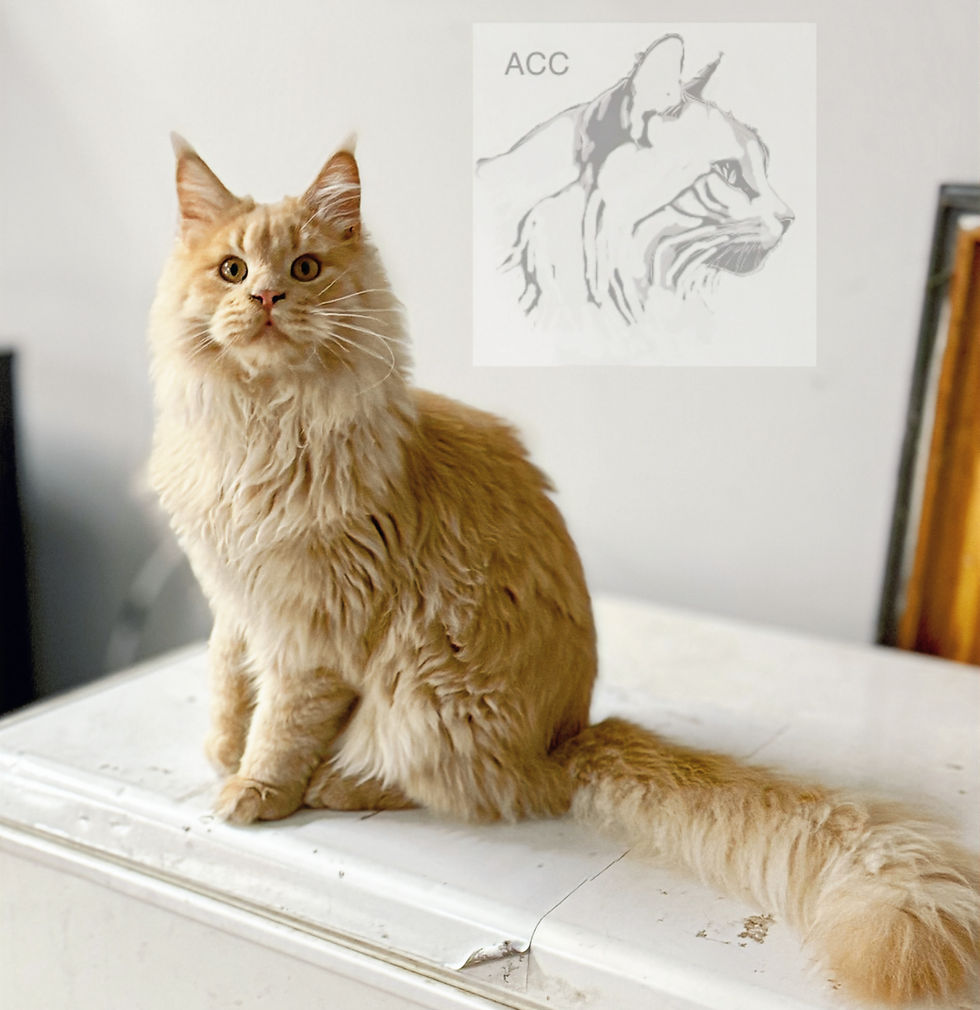
After following the names and dates, it is a pleasure to return to the cats themselves. The long outline, substantial frame, distinctive head, and flowing tail remain central to the breed's modern description. CFA's current profile also reflects the wide range of colors and patterns seen in Maine Coons. CFA's Maine Coon profile.
Those visible details offer another way to explore the breed. You might first notice the sweep of a tail, then the shape of a muzzle or the contrast within a coat. Looking carefully adds to the enjoyment of a photograph without needing to turn every image into a competition.
In our color-genetics guide, we explore another part of that fascination: the colors and patterns that make each Maine Coon so visually distinctive.
The Present-Day Chapter at AristoCoon
At AristoCoon, our cats are raised within our family home and known as individuals. Learning the breed's history adds another layer to that everyday appreciation: behind the cat in front of us is a much larger story of people noticing, admiring, and caring about Maine Coons.
Our queens and sires are the cats at the heart of our program today. We invite you to meet them and enjoy the expressions, coats, and presence that first draw so many people to the breed.
From a remembered Captain Jenks to a carefully saved collar and a painted portrait of Sandy, Maine Coon history has always included people who felt their cats were worth celebrating. We understand that feeling.
If this journey through the breed's past has deepened your curiosity, come and meet our kittens—the beginning of a new story, in a new family's home.


Comments