
Black Maine Coons: Solid Black, Black Tabby, Silver & Smoke Explained

From raven-coated panthers to frosted chinchillas and dramatic smokes, every black-based Maine Coon starts with the exact same pigment foundation: dense black eumelanin. Genetically, each of these cats carries dominant black pigment (B/-) and full color density (D/-) without the sex-linked red gene (Xᴼ), meaning their dark pigment is never diluted into blue or replaced by orange.
What transforms that single black pigment into four unmistakably different coats comes down to two primary genetic switches—the Agouti locus (A/a) and the Melanin Inhibitor locus (I/i)—refined by Wide-Band (Wb) modifiers that control how far pigment travels down each hair shaft.


Zeus
Black Silver Classic Tabby
Maverick
Black Silver Shaded
Polar Bear
Black Silver Chinchilla Torbie
(Torbie Shell)
Understanding how pattern (A/a) interacts with silver inhibition (I/i) makes it easy to identify any black-based Maine Coon accurately—even when heavy winter coats or extreme European silver lines blur the visual boundaries.
1. Solid Black Maine Coons (a/a, i/i)
A true Solid Black Maine Coon carries two copies of the recessive non-agouti gene (a/a), which switches off hair-shaft banding, paired with no melanin inhibitor (i/i). Dense black eumelanin saturates every guard hair and undercoat fiber from the tip all the way down to the follicle root at the skin.
Leather & Eyes: Both the nose leather and paw pads are solid black or dark seal, paired with vivid gold, copper, or green eyes.
Kitten Rusting: Solid black kittens often show temporary reddish-brown sun-tipping or faint ghost stripes until their heavy, glossy adult guard coat matures over three to five years.
Fever Coats vs. Genetics: If a mother experiences heat stress or illness late in pregnancy, solid black newborns can arrive with temporary frosted tips—a fever coat that sheds out completely to jet black, unlike a true genetic smoke.
2. Black Tabby ("Brown Tabby") Maine Coons (A/-, i/i)
One of the most common points of confusion for buyers is registry terminology: European registries such as FIFe classify this coat as Black Tabby (n 22–25), while TICA and CFA register the exact same cat as a Brown Tabby. Despite the warm tone, these cats do not carry the recessive chocolate gene (b/b), which does not exist in purebred Maine Coon standards.
Instead, at least one copy of the dominant Agouti gene (A/-) bands each background hair with alternating rings of black eumelanin and warm golden-brown phaeomelanin, while solid black pigment forms the crisp surface pattern:
-
Classic Tabby (n 22): Broad, dramatic swirls along the flanks forming a bullseye target and butterfly shoulder markings (tᵇ/tᵇ).
-
Mackerel Tabby (n 23): Narrow, vertical tiger stripes running down the sides from a dark dorsal spine line (Tᴹ/-).
-
Ticked & Spotted (n 25 / n 24): Agouti ticking across the body (Tiᴬ/-) with minimal barring, or broken mackerel/classic stripes forming distinct spots.
-
True Tabby Markers: Black Tabbies show the familiar forehead “M,” pale spectacles around the eyes, a lighter chin, and black paw pads. Nose leather can be brick red outlined in black or solid black.
3. Black Silver Maine Coons: Tabby, Shaded & Chinchilla (A/-, I/-)
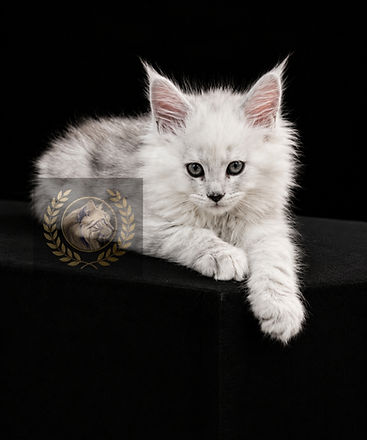
Adding at least one copy of the dominant Melanin Inhibitor gene (I/-) onto an agouti tabby (A/-) creates the Black Silver family. On a tabby coat, the Inhibitor gene selectively scrubs away warm yellow and reddish phaeomelanin from the background hairs, turning the golden-brown ground coat into icy, luminous silver-white while leaving the jet-black markings untouched.
Depending on underlying tabby modifiers and Wide-Band (Wb) polygenes selected in specialized lines, Black Silver expresses across three distinct tiers:
-
Black Silver Tabby (ns 22–25): Bold, high-contrast jet-black swirls or stripes set cleanly against a bright sterling-silver ground coat.
-
Black Silver Shaded (ns 11): Wide-Band modifiers push dark pigment up to the outer one-third of each hair, replacing distinct stripes with a misty pewter-and-charcoal mantle over a snow-white base.
-
Black Silver Chinchilla (ns 12): The most extreme wide-band expression restricts black tipping to the outer one-eighth of the hair shaft, creating a sparkling white coat framed by dark mascara eyeliner.
Clarity & Tarnishing: Residual warm pigment bleeding onto the muzzle or forelegs is known as tarnishing (rufism); selective silver breeding prioritizes crisp, cool-toned clarity without muddy yellowing.
4. Black Smoke Maine Coons (a/a, I/-)
The Black Smoke is the ultimate optical illusion in the Maine Coon world. Genetically, a Black Smoke is not a tabby—it is a non-agouti Solid Black cat (a/a) carrying the dominant Melanin Inhibitor gene (I/-). Because agouti banding is turned off while pigment at the base of the hair follicle is suppressed, each hair grows in chalk-white at the skin with deep black tipping on the outer shaft.
In traditional smokes, the cat can appear nearly solid black while resting, flashing a dramatic white undercoat along the lion's ruff, flanks, and britches whenever they walk or stretch. However, in selective European bloodlines carrying heavy Wide-Band modifiers, High and Extreme Black Smokes develop expansive white roots extending well over half the hair shaft—making them appear so pale and frosty that they are frequently mistaken for Black Silver Shaded cats.
How to Tell a High Black Smoke from a Black Silver Shaded
When evaluating an ultra-light, frosty kitten or adult, read the nose leather, facial markings, chin, and hair roots together to distinguish the non-agouti Black Smoke (a/a, I/-) from the agouti Black Silver Shaded (A/-, I/-).
Check the Nose Leather: Within these black-based silver coats, a pink or brick-red nose center rimmed in black confirms Agouti Silver. Black Smoke has solid black nose leather. TICA also permits a solid black nose on darker patterned tabbies and silvers, while mature Wide-Band Shadeds and Chinchillas typically show pink or brick centers outlined in black.
-
Inspect the Face & Chin: Black Smokes retain darker, solid-toned pigment across the muzzle and lower legs, lacking the pale white eye spectacles, pale ear rims, and white tabby chin of an agouti silver.
-
Look Past Kitten Ghost Stripes: Young Black Smokes commonly show phantom ghost markings on the torso or head because every cat carries hidden tabby pattern genes underneath a/a, but parting the coat reveals solid-tipped hairs over white roots rather than multi-banded agouti fur.