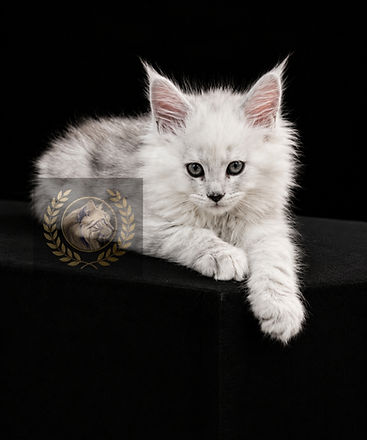

Blue Maine Coons: Solid Blue, Blue Tabby, Silver & Smoke Explained

From velvety slate panthers to misty pewter shadeds and snow-bright European smokes, every blue-based Maine Coon starts with the exact same pigment gene as a black cat: dominant black eumelanin (B/-). Cats do not carry a separate "grey" pigment gene. Instead, inheriting two copies of the recessive Dilution gene (d/d) on the Melanophilin locus causes black pigment granules to clump unevenly inside the growing hair shaft—scattering light so jet black transforms into cool slate, dove grey, and steel blue without carrying sex-linked orange (Xᴼ).
Once B/-, d/d establishes a dilute blue pigment base, two master genetic switches shape the coat: the Agouti locus (A/a), which divides true non-tabbies from tabbies, and the Melanin Inhibitor locus (I/i), which produces smokes and silvers—refined by Wide-Band (Wb) modifiers that govern how high the white undercoat rises.

Solid Blue
Coat Color Example

Blue Tabby
Coat Color Example

Blue Silver
Coat Color Example
*Under TICA’s Uniform Color Descriptions, non-tabby blues carry dark blue to slate-grey nose leather (subtle rosy undertones may appear in blue leather and paw pads), whereas blue tabbies carry rose leather outlined in dark blue. Wide-Band Shadeds and Chinchillas consistently display rose-to-pink centers.
Part 1: The Non-Agouti Family (a/a) — Solid Blue & Blue Smoke
Two copies of the recessive non-agouti gene (a/a) switch off hair-shaft banding completely, placing both Solid Blue and Blue Smoke outside the tabby family.
1. Solid Blue Maine Coons (B/-, d/d, a/a, i/i)
Without the melanin inhibitor (i/i), dilute blue eumelanin colors every guard hair and undercoat fiber evenly from tip to skin—often called a "Russian Blue in a lion’s coat."
Coat Tone & Texture: Shades range from soft lavender-dove to deep storm-cloud slate, with lighter silver-tipped guard hairs along the ruff and britches often giving plush winter coats a natural frostiness.
Leather & Eyes: Nose leather and paw pads are uniform dark blue to slate grey (sometimes showing faint rosy-plum undertones on the pads), paired with striking gold, copper, or green eyes.
Sun-Fading & Ghosting: Kittens commonly show faint ghost stripes that fade as their heavy adult guard coat matures over three to five years, while intense sunlight can warm slate tips slightly toward pewter-fawn.
2. Blue Smoke Maine Coons (B/-, d/d, a/a, I/-)
Genetically, a Blue Smoke is not a tabby—it is a Solid Blue cat (a/a, d/d) carrying at least one copy of the dominant Melanin Inhibitor gene (I/-). Pigment is suppressed at the base of the follicle, producing a luminous white root capped with slate-blue tipping:
Standard Blue Smoke: Pure white roots span roughly 25% to 45% of the hair shaft; the cat appears solid slate-blue at rest and flashes stark white contrast through the ruff and flanks in motion.
High & Extreme European Blue Smokes: Selective Wide-Band (Wb) modifiers push snow-white roots across 50% to 85%+ of each hair shaft, creating an ethereal, pale steel-and-ice mantle that closely mimics a Silver Shaded or Chinchilla.
Nose Leather: Every Blue Smoke carries solid dark blue to slate-grey nose leather from edge to edge and never develops a tabby-rimmed pink center.
Part 2: The Agouti Family (A/-) — All Blue Tabbies (Non-Silver & Silver)
Carrying at least one copy of the dominant Agouti gene (A/-) activates banded background hairs and unlocks true tabby patterning. Genetically and under TICA rules, every A/- blue-based Maine Coon is a Blue Tabby—split between warm-toned Non-Silver Blue Tabbies (i/i) and cool, icy Silver Blue Tabbies (I/-).
3. Non-Silver Blue Tabby Maine Coons (B/-, d/d, A/-, i/i)
Unlike Brown vs. Black Tabby, both TICA and European FIFe registries agree on the exact same name: Blue Tabby (EMS a 22–25). On an agouti coat without silver inhibition, dilute eumelanin forms deep slate-blue markings while dilute phaeomelanin bands the background coat in soft, warm tones:
Warm Patina Ground Coat: Deep blue-grey swirls or stripes sit against a pale bluish-ivory, buff, or oatmeal ground coat washed with TICA’s signature warm fawn patina across the face, back, and legs.
Recognized Patterns: Expressed in Classic (EMS a 22) bullseye swirls, Mackerel (EMS a 23) vertical stripes, Spotted (EMS a 24), and Ticked (EMS a 25) patterns.
True Tabby Markers: Displays a slate forehead "M," pale ivory spectacles around the eyes, pale inner ear rims, a lighter chin, and rose nose leather outlined in dark blue.
4. Silver Blue Tabbies: Patterned, Shaded & Chinchilla (B/-, d/d, A/-, I/-)
Adding the dominant Melanin Inhibitor (I/-) onto an Agouti Blue Tabby (A/-, d/d) scrubs away the warm oatmeal and fawn phaeomelanin bands, leaving cool slate-blue pigment suspended over a pure icy-white ground coat.
Depending on Wide-Band (Wb) depth in specialized European High Silver bloodlines, Silver Blue Tabbies express across three tiers:
Patterned Blue Silver Tabby: Crisp slate-blue Classic, Mackerel, Spotted, or Ticked markings (EMS as 22–25) contrast cleanly against a bright sterling-white ground coat devoid of warm fawn overcast.
Blue Silver Shaded: Wide-Band modifiers (EMS as 11) expand the snow-white base across two-thirds of the hair shaft, leaving a soft, misty pewter-blue mantle cascading down the spine, flanks, and tail.
Blue Silver Chinchilla: Extreme Wide-Band expression (EMS as 12) restricts delicate steel-blue tipping to the outer one-eighth of each hair, producing a sparkling snow-white coat framed by slate-blue eyeliner, lips, and nose liner.
Clarity vs. Tarnishing: Because non-silver Blue Tabbies naturally carry a warm fawn patina, selective Blue Silver breeding prioritizes crisp, cool-toned clarity free of sandy yellowing on the muzzle and paws.
How to Tell an Extreme Blue Smoke from a Blue Silver Shaded or Chinchilla
In European lines bred for heavy Wide-Band depth, an Extreme Blue Smoke (a/a, d/d, I/-) can appear so snowy and lightly tipped that it is easily mistaken not only for a Blue Silver Shaded or Chinchilla, but even for a pale Black Silver Chinchilla in indoor lighting. Three checks separate them with precision:
Check the Nose Leather: A distinct rose or pink center neatly rimmed in dark blue liner confirms an Agouti Blue Silver (A/-). Non-agouti Blue Smokes (a/a) maintain uniform dark blue to slate-grey nose leather edge to edge—keep in mind that newborn silver noses often start dark slate before opening up between 2 and 8 weeks of age.
Evaluate Ear Rims, Eye Spectacles & Chin: Agouti Blue Silvers preserve bright white inner ear rims, pale tabby spectacles, and a white-toned chin. Non-agouti Blue Smokes retain soft slate-blue pigment along the lower legs, ear margins, and muzzle.
Part the Coat & Confirm with DNA: Because dilute smoke kittens frequently show hazy ghost stripes, part the fur along the shoulder to distinguish single-tipped blue smoke hairs from banded agouti hairs. When extreme European lines overlap visually, pairing an Agouti (A/a) test with a Dilution (D/d) DNA test identifies the agouti or non-agouti foundation and distinguishes dilute Blue (d/d) from full-density Black (D/-).
Meet Our Blue Smokes

High Blue Smoke

High Blue Smoke

Extreme Blue Smoke

Extreme Blue Smoke

Extreme Blue Smoke