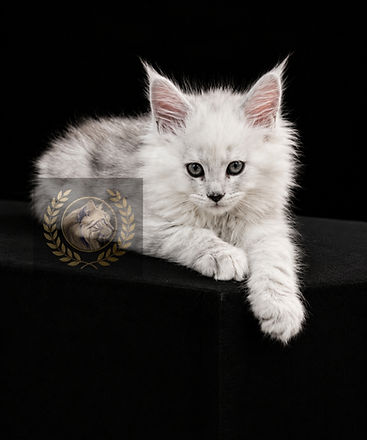

Red Maine Coons: Solid Red, Red Tabby, Cameo & Smoke Explained

From deep burnished mahogany lions to sunlit shell cameos that glow like spun porcelain and peach, every red-based Maine Coon owes its fiery palette to a single sex-linked switch: the dominant Orange gene (Xᴼ) on the X chromosome. Rather than modifying black pigment the way dilution does, Xᴼ replaces dark eumelanin in the hair shaft with warm phaeomelanin—while full color density (D/-) keeps the pigment in the dense red family rather than softening it into dilute cream (d/d).
Because the Orange locus sits on the X chromosome, red inheritance follows a distinct sex-linked pattern: males (Xᴼ/Y) need only one copy of Xᴼ from their mother to be red, whereas females (Xᴼ/Xᴼ) must inherit Xᴼ from both sire and dam (carrying a single copy produces a tortie or torbie instead). As a result, full red, cameo, and red smoke females are generally less common than males; their red color is a normal inherited trait.
Within that dense red foundation, two primary genetic switches—the Agouti locus (A/a) and the Melanin Inhibitor locus (I/i)—interact with European Wide-Band (Wb) modifiers to produce four distinct coat expressions.
At AristoCoon, these approximate white-root ranges reflect the appearances we observe across our silver and smoke lines and help illustrate our Standard, High, and Extreme descriptions.
Official TICA and FIFe registrations use formal pattern categories rather than "Standard," "High," or "Extreme." TICA and FIFe register silver-inhibited reds systematically as Red Smoke, Red Silver Tabby (where TICA uses Classic and FIFe’s EMS system uses Blotched for code 22), Red Silver Shaded (ds 11), and Red Silver Chinchilla in TICA or Red Silver Shell in FIFe (ds 12). In traditional North American breeder terminology, agouti silver-inhibited reds are also widely known as the Cameo series (Cameo Tabby, Shaded Cameo, and Shell Cameo).
Part 1: The Non-Agouti Family (a/a) — Solid Red & Red Smoke
In black and blue cats, two copies of the recessive non-agouti gene (a/a) switch off hair-shaft banding completely. Red pigment breaks that rule. Because sex-linked orange (Xᴼ) partially overrides a/a inside growing hair follicles, phaeomelanin continues to form subtle light-and-dark bands—meaning even genetically non-agouti Solid Reds and Red Smokes routinely display visible ghost striping across the flanks, legs, and forehead.
1. Solid Red Maine Coons (D/-, a/a, i/i, Xᴼ)
Without the melanin inhibitor (i/i), dense red phaeomelanin saturates the coat from tip to root in rich shades ranging from fiery tangerine to deep copper-mahogany.
Soundness vs. Ghost Markings: Selective breeding for deep, even pigment (or underlying ticked tabby alleles) produces a smoother, more uniform red coat, though faint phantom barring on the legs, tail, and forehead remains common—especially in kittens. In TICA, boldly marked non-agouti reds may even compete phenotypically in tabby classes despite testing a/a.
Leather & Lentigo Freckles: Red-series nose leather and paw pads range from rosy pink to hot pink. As red-series cats mature, many develop small, harmless black or dark brown pigment freckles (lentigo simplex) on their nose leather, lips, gums, or eyelids—a benign trait of orange genetics rather than tortoiseshell patching.
TICA Eye Color: Under TICA’s Maine Coon Breed Standard, eye color has no required link to coat color; Red Maine Coons may express any shade of green and/or gold (with blue and odd eyes accepted only in white or with-white cats).
2. Red Smoke Maine Coons (D/-, a/a, I/-, Xᴼ)
Genetically, a Red Smoke (sometimes nicknamed Cameo Smoke, EMS ds) is a non-agouti Solid Red cat (a/a) carrying at least one copy of the dominant Melanin Inhibitor gene (I/-). Because the Inhibitor gene suppresses warm red phaeomelanin far more aggressively than it suppresses black eumelanin, Red Smokes display one of the most dramatic visual transformations in the breed:
Standard Red Smoke: Pure chalk-white undercoat spans roughly 25% to 45% of the hair shaft beneath rich, fiery red tipping; the coat reads warm red at rest and parts in motion to flash stark snow-white roots through the ruff and flanks.
High & Extreme European Red Smokes: Selective Wide-Band (Wb) modifiers push snow-white depigmentation across 50% to 85%+ of each hair shaft. Because phaeomelanin is compressed into just the outer hair shafts, the red tipping softens into luminous apricot, peach, and champagne blush—as seen in our confirmed High Red Smokes Ansel and Isaiah, whose pale, frosted coats are easily mistaken at first glance for dilute Cream or Shell Cameo.
Part 2: The Agouti Family (A/-) — Red Tabby & Red Silver ("Cameo")
Carrying at least one copy of the dominant Agouti gene (A/-) switches on true tabby architecture, framing patterned or tipped red pigment with distinctly paler facial markings around the eyes, inner ears, and chin.
3. Non-Silver Red Tabby Maine Coons (D/-, A/-, i/i, Xᴼ)
Often casually called "orange tabbies" outside the show hall, registered Red Tabbies pair deep, vivid crimson-to-copper markings against a lighter, warm apricot-orange agouti ground coat:
Recognized Patterns: Expressed in bold Classic (d 22, Blotched in FIFe) bullseye swirls and shoulder butterflies, narrow Mackerel (d 23) tiger stripes, Spotted (d 24), and Ticked (d 25) patterns.
True Agouti Facial Contrast: Agouti Red Tabbies commonly display a pale creamy-ivory chin, pale spectacles encircling the eyes, and pale inner ear rims. Non-agouti reds can share these details, so we read them alongside the full coat and Agouti inheritance.
4. Red Silver ("Cameo") Maine Coons: Tabby, Shaded & Chinchilla (D/-, A/-, I/-, Xᴼ)
Adding the dominant Melanin Inhibitor (I/-) onto an Agouti Red Tabby (A/-) scrubs warm yellow-orange pigment out of the background bands, replacing the apricot ground coat with pure, luminous silver-white. Pairing a homozygous (I/I) parent ensures every kitten inherits the inhibitor base, whereas pairing two single-copy (I/i) parents carries a 25% statistical chance of producing a non-silver (i/i) kitten—which will express as either a Red Tabby or a Solid Red depending on its Agouti inheritance.
Our Milli and Winston illustrate the High Red Silver expression.
Guided by cumulative Wide-Band (Wb) polygenes in European silver lines, Red Silvers (Cameos) express across three refined tiers:
Red Silver Tabby / Cameo Tabby (ds 22–25): Rich red-to-apricot swirls or stripes contrast over a crisp silver-white ground coat (~40% to 55% white root depth in Standard expressions). In High Red Silver expressions, deeper Wide-Band influence expands the snow-white base to roughly 60%–70% of the hair shaft, softening bold red markings into glowing rose-gold and peach contrast against an icy white ruff and britches.
Red Silver Shaded / Shaded Cameo (ds 11): Wide-Band modifiers push pure snow-white fur across roughly two-thirds (~65% to 75%) of each hair shaft, dissolving side stripes into a warm rose-apricot or tangerine mantle cascading down the spine, flanks, and tail over a pristine white chest, ruff, and belly.
Red Silver Chinchilla / Shell Cameo (ds 12): Heavy Wide-Band expression leaves roughly seven-eighths (~85%+) of the coat sparkling snow white, dusted on the delicate outer hair tips with a sunlit blush of pale red-apricot across the topline, head, and tail.
Separating High Red Smoke, High Red Silver (Cameo) & Dilute Cream
Because the Melanin Inhibitor (I/-) lightens orange pigment so dramatically—while sex-linked orange (Xᴼ) allows ghost stripes on non-agouti coats—evaluating pale red-series kittens requires a different checklist than black or blue Maine Coons:
Why the Nose-Leather Shortcut Doesn’t Apply: On Black and Blue cats, a pink or rose center outlined in dark pigment is a useful agouti clue. On Red cats, both non-agouti Red Smokes and agouti Red Silvers (Cameos) have rosy-pink to hot-pink nose leather and paw pads, so nose color does not distinguish the two.
Read the Chin, Spectacles & Ear Rims—Not Body Stripes: Never rely on torso stripes alone, since non-agouti Red Smokes routinely carry phantom ghost markings. Instead, examine the muzzle and ears: Agouti Red Silvers (A/-) maintain distinctly white chins, bright white eye spectacles, and white inner ear rims, whereas non-agouti Red Smokes (a/a) typically retain warmer apricot-red pigment across the chin, whisker pads, and outer ear margins. Non-agouti reds can also have pale facial details, so the full coat and Agouti result complete the comparison.
Distinguishing Dense Red Inhibitor Coats from True Dilute Cream: High and Extreme Red Smokes (ds) and Red Silvers (ds 11 / 12 / 22–25) frequently look so soft peach, champagne, or ivory-blush that they visually overlap with genetically dilute Cream Smokes (es) and Cream Silvers (es 11 / 12 / 22–25). When visual traits overlap in pale European Wide-Band lines, pairing an Agouti (A/a) test with a Dilution (D/d) DNA test identifies the agouti or non-agouti foundation and distinguishes full-density Red (D/-) from dilute Cream (d/d).

High Red Smoke

High Red Smoke

High Red Silver

Standard Red Smoke