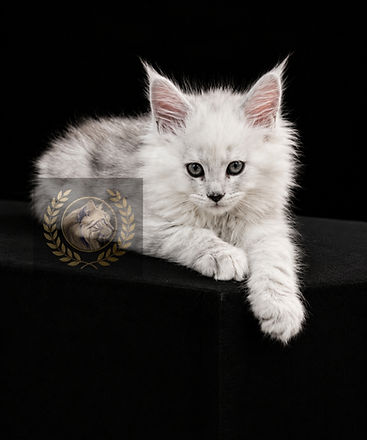

Tortie & Torbie Maine Coons: Black, Blue, Silver & Smoke Explained

No two tortoiseshell or torbie Maine Coons ever wear the exact same coat. Whether expressed as smoldering obsidian and ember red, soft slate and pastel cream, or spun-glass silver kissed with whisper-pale cameo peach, every cat in the Tortie and Torbie family is a living genetic mosaic created by the sex-linked Orange locus (Xᴼ/Xᵒ).
Most torties and torbies carry one non-orange X chromosome (Xᵒ, producing black or dilute blue eumelanin) alongside one orange X chromosome (Xᴼ, producing red or dilute cream phaeomelanin). Early in embryonic development, each pigment-producing cell randomly switches off one of its two X chromosomes through X-inactivation (Lyonization). Every cell descended from that point keeps the same X chromosome active, locking in a permanent, one-of-a-kind tapestry of dark and warm pigment zones. Because this dual-color inheritance normally involves two X chromosomes (Xᴼ/Xᵒ), roughly 99.9% of tortoiseshell cats are female, with rare males arising through genetic events such as XXY chromosome configurations, chimerism, or somatic mosaicism.
Once Xᴼ/Xᵒ establishes that dual-color foundation, three genetic switches organize the entire family into eight distinct coat branches:
Color Density vs. Dilution (D/d): Full density (D/-) creates bold Black & Red coats, while two copies of recessive dilution (d/d) soften both pigments simultaneously into cool Blue & Cream.
Non-Agouti vs. Agouti (A/a): Recessive non-agouti (a/a) produces non-tabby Torties, while dominant agouti (A/-) switches on true tabby patterning to create Torbies (tabby torties, also called patched tabbies).
Melanin Inhibitor (I/i) & Wide-Band (Wb): Non-inhibited coats (i/i) carry rich color to the skin, while the dominant Melanin Inhibitor (I/-) clears pigment at the root to produce Tortie Smokes (a/a, I/-) and Silver Torbies (A/-, I/-)—further shaped from Standard to High and Extreme by European Wide-Band (Wb) polygenes.
At AristoCoon, these approximate white-root ranges reflect the appearances we observe across our smoke and silver lines and help illustrate our Standard, High, and Extreme descriptions.
Official TICA and FIFe registrations use formal pattern categories rather than "Standard," "High," or "Extreme." TICA registers smoke tortoiseshells as Black Smoke Tortie and Blue Smoke Tortie, whereas FIFe’s EMS system uses Black Tortie Smoke (fs) and Blue Tortie Smoke (gs). Among agouti cats, TICA uses Brown (Black) Torbie, Blue Torbie, Black Silver Torbie, and Blue Silver Torbie (including Shaded and Chinchilla varieties), whereas FIFe uses Tortie Tabby and Tortie Silver, substituting Blotched where TICA uses Classic (22) and Shell where TICA uses Chinchilla (12).
Dense vs. Dilute Foundations: Black & Red (D/-) vs. Blue & Cream (d/d)
Every tortie and torbie variety exists in two parallel color palettes governed by the Melanophilin Dilution locus (D/d):
Dense Black & Red (f & fs series, B/-, D/-): Combines rich black eumelanin with fiery red-to-apricot phaeomelanin for dramatic, high-contrast warmth. On silver-inhibited coats (fs and fs 11 / 12 / 22–25), the Melanin Inhibitor suppresses red phaeomelanin far more aggressively than black eumelanin—softening dense red zones into pale peach, champagne, and cameo blush right beside jet-black smoke or tipping. Pale cameo-toned areas on a dense tortie smoke or silver torbie often visually mimic cream without carrying dilution.
Dilute Blue & Cream (g & gs series, B/-, d/d): Inheriting two copies of recessive dilution (d/d) causes pigment granules in both X-chromosome populations to clump unevenly and scatter light—transforming jet black into cool slate blue and fiery red into pastel buff-cream simultaneously. Traditionally nicknamed Blue-Cream in North America, TICA uses Blue Tortie, Blue Smoke Tortie, Blue Torbie, and Blue Silver Torbie for the dilute branch. In FIFe’s EMS system, the corresponding codes are g, gs, g 22–25, and gs 22–25, 11, 12.
Part 1: The Non-Agouti Family (a/a) — Torties & Tortie Smokes
Cats carrying two copies of the recessive non-agouti gene (a/a) have tabby hair-shaft banding switched off in all black or blue pigment zones, placing both Torties and Tortie Smokes outside the tabby family.
1. Non-Inhibited Torties: Black Tortie (f) & Blue Tortie (g)
Without the melanin inhibitor (i/i), pigment saturates each hair from tip to skin across an unrepeatable blend of mingled or patched color:
Black Tortie (f): Velvety jet black intermixed with warm shades of bright red and deep mahogany-amber.
Blue Tortie (g): Soft dove-to-slate blue blended with cool, pastel buff-cream.
Why Red & Cream Patches Still Show Stripes: Even though a true Tortie is genetically non-agouti (a/a), sex-linked orange (Xᴼ) partially overrides a/a inside orange hair follicles. Faint ghost striping inside a cat’s red or cream patches is completely normal on a non-agouti Tortie—true Torbie status is always judged inside the black or blue zones.
2. The Smoke Branch: Black Smoke Tortie (fs) & Blue Smoke Tortie (gs)
Adding at least one copy of the dominant Melanin Inhibitor (I/-) onto a non-agouti tortie (a/a) suppresses pigment at the base of the follicle, weaving two smoke coats onto one cat—Black Smoke + Red Smoke (fs) or Blue Smoke + Cream Smoke (gs)—over a shared luminous white undercoat.
Guided by selective European Wide-Band (Wb) modifiers, Tortie Smokes express across three dramatic visual tiers:
Standard Tortie Smoke (~25% to 45% white root): Showcased in our Manon (Standard Black Tortie Smoke), the cat reads as a rich dark tortoiseshell or blue-cream at rest, flashing stark chalk-white roots through the ruff and flanks in motion.
High Tortie Smoke (~50% to 75% white root): Wide-Band modifiers push snow-white depigmentation past the midpoint of the hair shaft so white fur spills openly through the lion's ruff, chest, and flanks beneath misty black/blue smoke and peach-or-champagne flames.
Extreme Tortie Smoke (~75% to 85%+ white root): Showcased in our Joan Jett (Extreme Black Tortie Smoke), heavy Wide-Band depth leaves a snow-bright mantle veiled at the outer tips with soot-black (or steel-blue) smoke and whisper-soft cameo or bisque blushes.
Explore the Dedicated Guide: Dive deeper into genetics, root ratios, and visual comparisons on Black Tortie Smoke Maine Coons — Standard, High & Extreme.
Part 2: The Agouti Family (A/-) — Torbies & Silver Torbies
Carrying at least one copy of the dominant Agouti gene (A/-) switches on banded background hairs inside the dark (Xᵒ) pigment zones, creating a Torbie—a true tabby patterned in black or blue and overlaid with random mottling or patches of red or cream.
3. Non-Silver Torbies: Brown (Black) Torbie (f 22–25) & Blue Torbie (g 22–25)
Without the silver inhibitor (i/i), Torbies combine crisp tabby architecture with rich tortoiseshell warmth:
Brown (Black) Torbie (f 22–25): Dense black Classic (22, Blotched in FIFe), Mackerel (23), Spotted (24), or Ticked (25) tabby markings over a warm coppery-apricot agouti ground coat, splashed with vibrant red tabby patches.
Blue Torbie (g 22–25): Deep slate-blue tabby markings over a warm bluish-ivory and fawn-patina ground coat, overlaid with soft pastel cream patches.
Signature Agouti Framing: Inside their black or blue facial zones, Torbies display a dark forehead "M," pale eye spectacles, pale inner ear rims, and a lighter chin.
4. The Silver Torbie Branch: Patterned, Shaded & Chinchilla (fs & gs series)
Adding the dominant Melanin Inhibitor (I/-) onto an Agouti Torbie (A/-) scrubs warm yellow and fawn pigment out of the background bands while transforming red or cream patches into glowing cameo or champagne highlights over a sterling-to-snow-white ground coat. Pairing a homozygous silver (I/I) parent ensures every kitten inherits the inhibitor base, whereas pairing two single-copy (I/i) parents carries a 25% statistical chance of producing a non-inhibited (i/i) kitten—whose Tortie, Torbie, Solid, or Tabby expression depends on its Agouti and sex-linked Orange inheritance.
Because Wide-Band (Wb) inheritance is polygenic rather than a single-gene switch, coat lightness across the Silver Torbie branch reflects cumulative European Wide-Band depth rather than whether a cat carries one (I/i) or two (I/I) copies of the Inhibitor allele:
Patterned Black & Blue Silver Torbies (fs 22–25 / gs 22–25): Crisp jet-black or slate-blue swirls and stripes contrast against a bright silver-white ground coat (~40% to 55% white root in Standard expressions, rising to ~60%–70% in High Silver Torbies), accented by rose-apricot or pale cream patches.
Black & Blue Silver Shaded Torbies (fs 11 / gs 11): Wide-Band modifiers expand the snow-white undercoat across roughly two-thirds (~65% to 75%) of each hair shaft, dissolving torso stripes into an open pewter-charcoal or misty slate mantle mingled with shaded cameo or champagne blush.
Black & Blue Silver Chinchilla Torbies (fs 12 / gs 12): Showcased in our Polar Bear, Paddington, and Yogi (Black Silver Chinchilla Torbies), heavy Wide-Band expression leaves roughly seven-eighths (~85%+) of the coat glistening snow white, delicately dusted on the outer hair tips with fine black (or steel-blue) sparkle and subtle whispers of shell-peach or cream.
Explore the Dedicated Guide: See how ultra-pale tipped torbies develop on Black Silver Chinchilla Torbie Maine Coons.
Skin, Eyes & Separating High Tortie Smokes from Silver Torbies
Because High and Extreme Tortie Smokes (fs / gs) and Silver Shaded or Chinchilla Torbies (fs 11, 12 / gs 11, 12) both pair snow-white undercoats with dark tipping and pale peach-or-cream highlights, accurate identification requires checks specific to torties and torbies:
TICA Nose Leather & Paw Pad Rules: Under TICA’s Uniform Color Descriptions, nose leather and paw pads on both Torties and Torbies correspond to either or both parent colors, frequently forming a speckled or patched pattern. Because asymmetrical rosy-pink and black/slate mottling occurs in both non-agouti Tortie Smokes and agouti Silver Torbies wherever Xᴼ pigment crosses the nose or toes, nose mottling alone never separates Smoke from Silver—though a brick or rose center neatly outlined in dark liner inside a purely black- or blue-furred nasal zone points toward Agouti.
TICA Maine Coon Eye Color: In TICA’s Maine Coon Breed Standard, eye color bears no required link to coat color—Tortie and Torbie Maine Coons across every branch may have any shade of green and/or gold, while blue and odd eyes are accepted only in white or with-white cats.
Read Purely Black (Xᵒ) or Blue (Xᵒ, d/d) Zones & Confirm with DNA: Always ignore red, peach, or cream areas, which lighten facial hair and show ghost stripes regardless of agouti status. Inspect purely black or blue facial zones for agouti white inner ear rims and eye spectacles versus solid dark smoke margins, part a dark patch on the shoulder to check banded agouti hairs against single-tipped smoke hairs, and when extreme European lines overlap visually, pair an Agouti (A/a) test with a Dilution (D/d) DNA test to identify the agouti or non-agouti foundation and distinguish dense Black/Red (D/-) from dilute Blue/Cream (d/d).