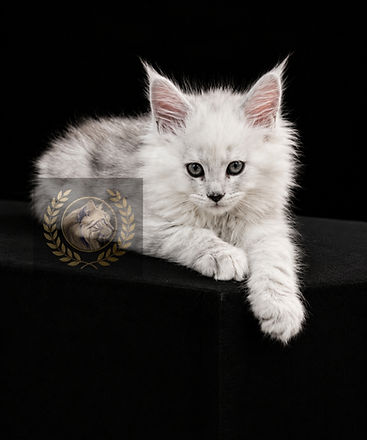
Black Tortie Smoke Maine Coons: Standard, High & Extreme Explained
Few Maine Coon coats rival the living artistry of a Black Tortie Smoke—an unrepeatable mosaic of obsidian smoke, glowing ember red, soft cameo peach, and luminous chalk-white roots.
Understanding the Coat Names
Genetically, every Black Tortie Smoke combines four core building blocks: recessive non-agouti (a/a), dominant Melanin Inhibitor (I/-), dense black pigment (B/-, D/-), and heterozygous sex-linked orange (Xᴼ/Xᵒ).
Before evaluating coat tiers, buyers should note one key registry naming difference: European registries such as FIFe classify this coat as Black Tortie Smoke under EMS code fs, while TICA officially registers the exact same cat as a Black Smoke Tortie within the Traditional Silver/Smoke Division.
Black Tortie Smokes are almost always female. Rare males can occur through unusual chromosome combinations, chimerism, or mosaicism.
Standard Tortie Smoke
a/a, I/-, Xᴼ/Xᵒ · EMS fs
Velvety dark tortie; flashes white in motion.
High Tortie Smoke
a/a, I/-, Xᴼ/Xᵒ (+ Wb) · EMS fs
Charcoal smoke clouds & apricot-cameo flames, with pale roots openly visible through the ruff and flanks.
Extreme Tortie Smoke
a/a, I/-, Xᴼ/Xᵒ (+ high Wb) · EMS fs
Snow-white mantle veiled in soot & shell peach.
Black Silver Torbie
A/-, I/-, Xᴼ/Xᵒ · EMS fs 22–25, 11, 12
True agouti tabby or shaded coat with red patches.
TICA uses Black Smoke Tortie and FIFe uses Black Tortie Smoke (fs) for Standard, High, and Extreme expressions.
These three breeder tiers describe how far white root depigmentation rises up the hair shaft based on Inhibitor zygosity (I/I vs. I/i) and European Wide-Band (Wb) polygenes.
Standard, High & Extreme Black Tortie Smoke Tiers
In specialized European Maine Coon lines, selective pairing for Wide-Band (Wb) modifiers and coat clarity transforms how dramatically the white undercoat breaks through the dark tortoiseshell surface.
Standard (Classic) Black Tortie Smoke
Standard Black Tortie Smokes express the classic TICA standard: “Silver white undercoat deeply tipped with black and various shades of red; appears tortoiseshell in repose.”
Root-to-Tip Appearance: Pure silver-white roots lie beneath deep black and rich fiery-red outer color, remaining largely hidden when the coat rests.
Hidden Drama: Resting, the cat reads as a rich, smoldering black-and-red tortoiseshell, flashing stark chalk-white contrast whenever she walks, stretches, or parts her winter ruff.
Meet our Standard Black Tortie Smokes: Lysandra and Manon.

Standard Black Tortie Smoke

Standard Black Tortie Smoke
High Black Tortie Smoke
High Black Tortie Smokes carry selective Wide-Band (Wb) modifiers that push depigmentation past the midpoint of the hair shaft so the white base can no longer hide when the cat stands still.
Root-to-Tip Appearance: Snow-white roots spill openly through the lion’s ruff, chest, flanks, ear tufts, and britches.
Luminous Cameo Contrast: Because Wide-Band amplifies phaeomelanin suppression, the red zones soften into bright peach, champagne, and shaded-cameo flames swirling against misty charcoal-black smoke.
Meet our High Black Tortie Smokes: Dutchess, Violet, and Stevie Nicks.

High Black Tortie Smoke

High Black Tortie Smoke
Extreme Black Tortie Smoke
Representing the pinnacle of European high-smoke breeding, Extreme Black Tortie Smokes combine heavy Wide-Band accumulation—and often homozygous Inhibitor (I/I) genetics—to restrict dark pigment to the outer hair tips.
Root-to-Tip Appearance: Sparkling chalk-white fur dominates the coat, veiled with delicate soot-black tipping and whisper-soft shell-cameo blushes.
Subtle Red Expression: On extreme coats, red tipping can be pushed so close to the hair ends that warm peach-gold tones show primarily across the face, ears, hocks, dorsal spine, or tail.
Meet our Extreme Black Tortie Smokes: Joan Jett and Marie.

Extreme Black Tortie Smoke

Extreme Black Tortie Smoke
The Genetics Behind the Dual-Color Smoke Effect
A Black Tortie Smoke is essentially two smoke coats—Black Smoke and Red Smoke—woven onto a single non-agouti (a/a) cat through four distinct biological mechanisms:
Random X-Inactivation (Lyonization): Early in embryonic development, each pigment cell randomly switches off one X chromosome, locking in a permanent, one-of-a-kind patchwork of black (Xᵒ) and orange (Xᴼ) zones.
Stronger Inhibition on Red Pigment: The Melanin Inhibitor gene (I/-) suppresses red phaeomelanin far more aggressively than black eumelanin, turning red patches into pale apricot, rose-gold, or creamy cameo right beside jet-black smoke.
Dense Red vs. True Dilute Cream: Pale cameo-toned patches on a dense (D/-) Black Tortie Smoke often mimic cream without carrying dilution (d/d, Blue-Cream Smoke, EMS gs).
Ghost Stripes Inside Red Patches: While non-agouti (a/a) turns off banding in black fur, sex-linked orange (Xᴼ) overrides a/a—so red patches routinely show faint cameo striping without making the cat a torbie.
TICA Nose Leather & Paw Pad Rules: Why Tortie Smokes Break the “Solid Black Nose” Rule
Black Tortie Smokes and Black Silver Torbies can both have black, pink, or mottled nose leather and paw pads. Pink pigment alone does not establish whether a cat is agouti.
Under TICA Uniform Color Descriptions, tortoiseshell nose leather and paw pads match either or both of the two parent colors, often forming a speckled or patched pattern corresponding to body color placement:
Black Zones (Xᵒ): Produce solid black or dark charcoal nose leather and paw pads.
Red Smoke Zones (Xᴼ): Produce rosy pink to brick-pink skin wherever orange pigment crosses the nasal bridge, lips, or toes.
Legal Combinations: A genetically pure, non-agouti (a/a) Black Tortie Smoke can have solid black leather, split/mottled black-and-pink leather, or even a fully pink nose if a red blaze covers her nose.
Marie: From Kitten to Adult
Smoke kittens can darken or pass through a hazy juvenile coat before their brighter undercoat becomes more apparent. The timing and balance of pale and colored fur vary with the individual cat, coat maturity, and season.
Marie’s kitten and adult portraits follow her Extreme Black Tortie Smoke expression as her ruff, flanks, and pale coat develop. These photographs show the transformation within one individual cat.
Extreme Black Tortie Smoke

Extreme Black Tortie Smoke
How to Tell a High Black Tortie Smoke from a Black Silver Torbie
Because Extreme and High Black Tortie Smokes (a/a, I/-, Xᴼ/Xᵒ, EMS fs) look remarkably frosty—and can carry pink on their noses and ghost stripes in their red patches—they are frequently confused with Agouti Black Silver Torbies, including Silver Shaded Torbies (EMS fs 11) and Silver Chinchilla Torbies (EMS fs 12). Read the nose within its surrounding fur color, then use the black-zone facial details, hair roots in a pure black patch, and Agouti (A/a) DNA to separate the two foundations.
Inspect the Black (Xᵒ) Facial Zones: Focus on purely black-pigmented areas around the eyes and ears. Silvery-white inner ear rims and pale spectacles reveal the agouti detailing of a Silver Torbie, while a Tortie Smoke retains darker pigment through those same black zones. Read these features alongside the hair roots and the rest of the coat.
Read Nose Pigment Within Its Fur Color: Asymmetrical pink-and-black mottling occurs in both Tortie Smokes and Silver Torbies wherever orange crosses the nose. A brick center rimmed in black within a black-furred zone indicates Agouti. The surrounding fur color gives that nose detail its meaning.
Part a Pure Black Patch & Confirm via DNA: Red patches can show striping on both foundations, so examine a purely black patch on the shoulder or flank. Read the white roots and colored outer portions of smoke hairs alongside the banding of agouti fur. An Agouti (A/a) DNA result identifies the underlying foundation and completes the picture drawn by the black-zone ear rims, eye spectacles, and hair roots.
Meet Our Black Tortie Smokes
Standard: Lysandra and Manon.
High: Dutchess, Violet, and Stevie Nicks.
Extreme: Joan Jett and Marie.
Still developing: Reese and Danika are young; their adult expression is still developing. Anna is a Tortie Smoke with no expression tier assigned.
Explore our Smoke Tortie kittens and See Them Grown Up in matched kitten-and-adult photographs.
Find Your AristoCoon Companion
At AristoCoon Cattery in Conway, South Carolina, in the Greater Myrtle Beach Area, we welcome families drawn to the individual beauty of rare European Maine Coons.
Explore our Available Kittens and learn about our Adoption Process.